






2025/12/15 16:04:47
The China National Intellectual Property Administration issued Order No. 84 on November 13, 2025, which significantly revised the Guidelines for Patent Examination. The purpose of this revision is to improve the patent examination standards for emerging fields and new formats, and to adjust and optimize the issues that urgently need to be addressed and have mature consensus in examination practice.
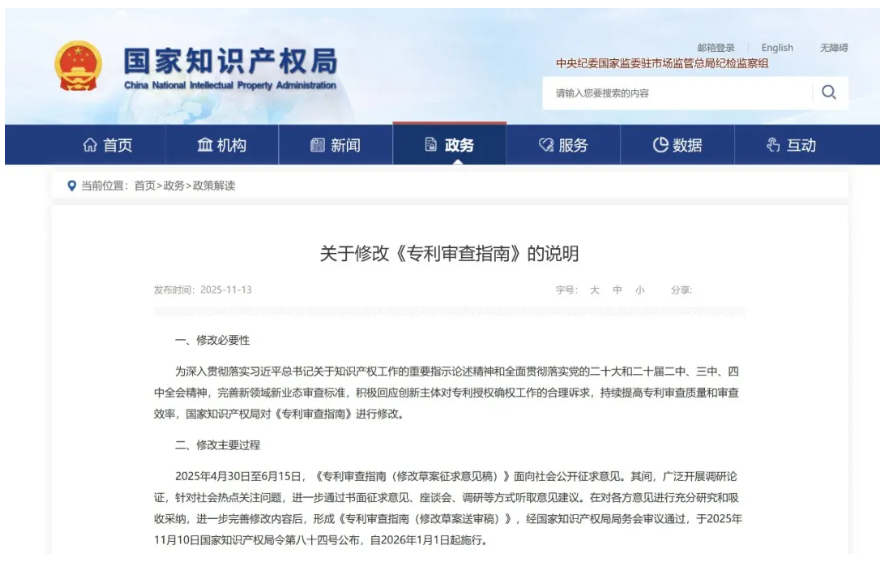
This article will focus on the modifications to the patent invalidation procedure in the new guidelines (Chapter 3 of Part 4), and provide a detailed interpretation of its content, background, and potential impacts.
The new guidelines will be implemented from January 1, 2026, aiming to further enhance the fairness and efficiency of invalid procedures.
The new guidelines, which will be implemented from January 1, 2026, have made three important revisions to Chapter 3 of Part 4, which involves invalid procedures. The specific content is as follows:
One Regulating malicious invalid requests
The new guidelines have added a new item (2) to Chapter 3, Section 3.2 of Part Four, which clearly stipulates that in the case where the request for invalidation is not made based on the true intention expressed by the requester, the request for invalidation shall not be accepted. This amendment aims to regulate the phenomenon of filing invalid requests under the guise of others in practice.
For example, in the invalidation administrative dispute case (2016) Jing 73 Xing Chu 6453 heard by the Beijing Intellectual Property Court, the invalidation requester clearly stated in the administrative litigation that the invalidation procedure was not initiated by themselves. The court found in the judgment that "although the examination of the Patent Reexamination Board meets the relevant conditions for accepting the invalidation request in the form of the case, it cannot be denied that the invalidation request in question violates the wishes of the applicant Lu Tong himself and is not Lu Tong's true intention. Therefore, the acceptance of the invalidation request of this patent by the Patent Reexamination Board is illegal and the administrative examination procedure is illegal
In this case, the request for invalidation is not based on the true intention of the requester, and is often accompanied by the act of fabricating relevant materials such as request letters, proxy signatures, or forged authorization documents. Such behavior seriously violates the principle of good faith and damages the credibility of the patent invalidation system and market competition order, therefore effective regulation is urgently needed.
This modification has a positive significance in curbing malicious invalid requests, and also provides a clear legal basis for the patent review invalidation department to verify the identity and true intention of the invalid requester.
For example, the invalidation department of patent reexamination may require the invalidation requester to bring valid identification documents to the acceptance hall to handle identity verification and other related procedures; It is also possible to request the invalid requester to submit a valid notarized certificate that verifies the requester's true identity, witnesses their statement of true intention, and signs a commitment letter.
It should be noted that this amendment only examines the true intention expressed by the invalid requester, and does not require the invalid requester to have an interest in the case. Therefore, it does not constitute a restriction on the public's right to request invalidation.
When representing such cases, patent agencies should strictly verify the identity and intention of the invalid requester, and actively cooperate with the procedural requirements of the examination department to avoid requests being rejected due to formal flaws.
Two Further clarification of the principle of 'no more reasoning'
The new guidelines will revise the provision on "non bis in idem" in Chapter 3 of Part Four to read: "If a request for invalidation is made for the same or substantially the same reasons and evidence after the review and invalidation department has made an invalidation request decision on a patent right, it will not be accepted, except for situations where the reasons or evidence are not considered by the decision due to time limits or other reasons." The key change is to expand the original "same reasons and evidence" to "same or substantially the same reasons and evidence.
In the practice of invalidation procedures, some invalidation claimants attempt to circumvent the principle of "non bis in idem", such as simply adjusting and transforming the reasons or evidence for invalidation declaration in form, or using same family patents with the same public content as evidence.
For example, in case No. 332 of the Supreme People's Court of China (2023), the reasons presented by the applicant for invalidation in the subsequent invalidation procedure essentially denied the relevant determination of the previous invalidation examination decision. The Supreme People's Court believes that this situation should also be recognized as the same reasons.
The above examples all belong to situations where the legal facts are essentially the same, and still fall within the scope of the principle of "non bis in idem" regulation. If the invalid requester is allowed to make another invalid request using substantially the same reasons and evidence, it is not only a waste of limited examination resources, but also increases the burden on the patentee to respond.
The purpose of this revision is to address the issues that exist in the aforementioned practices, and to explicitly include substantially identical reasons and evidence within the scope of the principle of non bis in idem. This move balances the interests of both the patentee and the invalidation requester, ensuring the requester's legitimate and reasonable right to request invalidation while avoiding unnecessary litigation and interference. After the implementation of the new examination guidelines, the invalidation department of patent reexamination can refuse to accept duplicate invalidation requests. For cases that have already been accepted, the examination department can also reject them, effectively avoiding the waste of administrative and judicial resources caused by duplicate invalidation procedures, and preventing abuse of litigation and litigation fatigue.
Three Modification of Claims in Invalid Programs
This revision adds a new section 4.6.4 "Submission of Modified Text" to Chapter 3, Section 4.6 of Part 4 of the Patent Examination Guidelines, clarifying the formal requirements and relevant procedural rules for submitting amended text of claims in the invalidation procedure.
Firstly, in terms of document format, this amendment explicitly requires the patentee to submit a full-text replacement page and a comparison table when modifying the claims. In practice, patent owners often use non-standard methods (such as only describing modifications in the opinion statement), resulting in unclear examination texts. This modification will help prevent patent owners from losing their rights due to changes in the form or procedure of the text during the invalidation process, and also improve the efficiency of subsequent examinations.
Secondly, the new guidelines clearly stipulate that if multiple modified texts submitted by the patentee in the same invalidation request review procedure all comply with the provisions of section 4.6.3 of this chapter, the last submitted modified text shall prevail, and the remaining modified texts shall not be used as the basis for examination. The purpose of this modification is to create clear expectations for both parties regarding the determination of the reviewed text. In invalid practice, there have been cases where patent owners have submitted multiple claims for modification, and even abandoned the last modification during oral proceedings. This requires the invalidation requester to prepare contingency plans for the multiple modification proposals submitted by the patent owner, increasing the burden on the invalidation requester.
This rule aims to create clear expectations for the parties involved and avoid the "surprise attack" behavior where the patentee needs to prepare multiple contingency plans through multiple modifications or temporarily abandon modifications during oral proceedings. The examiner will only review the final version, and invalid requesters can also focus on preparation based on this to improve response efficiency.
Overall, the revision of the invalidation procedure in the new guidelines has further improved the patent administrative confirmation mechanism, effectively balancing the interests of patent owners and requesters, enhancing the efficiency of examination and the authority of results, and making the dispute resolution of patent administrative confirmation procedures more efficient, fair, and reasonable. Patent practitioners need to pay more attention to evidence preparation and revision strategies to adapt to the new regulations. Meanwhile, continuous attention should be paid to potential impacts, such as the implementation costs of identity verification procedures, in order to further optimize practices.
