






2026/6/2 10:19:19
February
1. 2025 China Top 100 list of effective invention patent holders
Recently, Dawei released the “2025 China Top 100 list of effective invention patent holders”. The data on the list represents the number of effective invention patents held by Chinese patent holders as of December 31, 2025.
The Chinese Academy of Sciences takes the lead, with the highest number of effective invention patents, boasting 101,429 valid patents. The State Grid maintains a significant innovation advantage, ranking second with 79,336 valid invention patents. Huawei ranks third, with 52,629 valid invention patents.
Excerpt from the 2025 China Top 100 list of effective invention patent holders
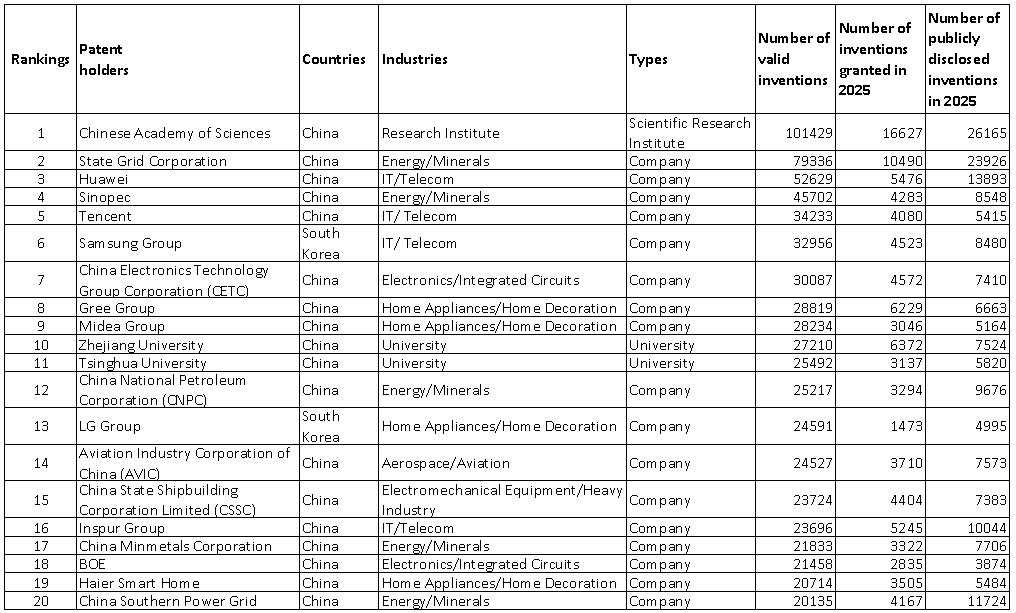
Among the top 100 entities, 83 are from Mainland China, 9 are from Japan, followed by 4 from the US, 3 from South Korea, and 1 from Germany.
In terms of industry sector, the effective invention patents on the TOP100 list are primarily concentrated in the IT/Telecom, Home Appliances/Home Decoration, and Energy/Minerals industries, accounting for 38, 11, and 11 of the total respectively.
Among the TOP100 innovators, 61 are enterprises, while 39 are universities and research institutes.
2. The State Administration for Market Regulation Releases Typical Cases of Unfair Competition in the AI Field
I. The Market Supervision Bureau of Chaoyang District, Beijing investigated and dealt with the case of Beijing Aolande Information Technology Co., Ltd. using the internet to cause confusion
Beijing Aolande Information Technology Co., Ltd. was fined RMB 5,000 for engaging in unfair competition by using the words and icon "DeepSeek" when promoting its software involved in the case, and by leveraging its popularity through bidding for rankings to gain improper benefits. During the investigation and handling process, the market supervision department promptly stopped the illegal activities of the party involved by following online hot topics.
II. The Market Supervision Bureau of Xuhui District, Shanghai investigated and handled the case of Shanghai Shangyun Network Technology Co., Ltd. using the internet to cause confusion
When operating the "ChatGPT Online" WeChat public account, Shanghai Shangyun Network Technology Co., Ltd. used an avatar highly similar to the official images of OpenAI and claimed to be the "ChatGPT Chinese version". This deliberately confused the services provided by its calling interface with the "ChatGPT" product itself for profit. As a result, the company was fined RMB 62,692.7 for unfair competition. This case serves as a warning against commercial confusion in the field of AI.
III. Market Supervision Bureau of Hangzhou, Zhejiang province investigated and dealt with the case of Min XX infringing trade secrets
As a development engineer at a computing company, Min XX, despite having signed a non-disclosure agreement and being responsible for AI and big data product R&D, unauthorizedly used his work key to access the company’s test server and downloaded 15.88 GB of trade secret files containing data algorithm technologies. His actions violated relevant laws and regulations, resulting in a fine of RMB 360,000. The investigation and penalty in this case have effectively deterred the use of technical means to infringe upon trade secrets.
IV. Market Supervision Bureau of Xihu District, Hangzhou City Investigates and Handles Case of Hangzhou Boheng Cultural Media Co., Ltd. Engaging in Confusion via the Internet
Hangzhou Boheng Cultural Media Co., Ltd. was fined RMB 30,000 for unauthorized use of wording, highly similar icons, and page designs identical to those of the official DeepSeek website on its self-built “DeepSeek Local Deployment” website, which misled users into making payments and constituted acts of confusion. The investigation and handling of this case have helped maintain public trust in domestic technology and guided the AI market toward standardized and orderly development.
3. Mediation Work and Typical Cases of the Intellectual Property Tribunal under the Supreme People's Court
On the morning of January 28, 2026, the Supreme People's Court held a press conference to introduce the mediation work and typical cases of the Intellectual Property Tribunal. Over the past seven years, the court has concluded a total of 13,263 civil second-instance substantive cases, with 4,997 cases resolved through mediation or withdrawal after mediation, resulting in a mediation/withdrawal rate of 37.7. This rate is significantly higher than the national average for civil second-instance cases and general intellectual property civil second-instance cases during the same period.
The Intellectual Property Tribunal of the Supreme People’s Court selected 6 typical cases from its recent mediation efforts for release:
1) Standard Essential Patent Disputes – A series of invention patent infringement cases involving a foreign company, a Chongqing-based tech company, and a Shenzhen-based tech company. The tribunal applied the “oriental wisdom” of combining mediation with adjudication to facilitate a global settlement package.
2) From Infringement to Licensing – A series of patent infringement disputes between a state-owned enterprise (Pan X) and six private enterprises, including Zhong X. Through circuit trials and on-site mediation, the tribunal guided the parties toward transforming infringement disputes into licensing cooperation.
3) Decade-Long Software Copyright Dispute – A computer software copyright infringement case involving a Fujian software development company, a Beijing office software company, and a Zhuhai office software company. By leveraging decided cases to promote mediation, the tribunal persistently worked toward a substantive resolution of the long-standing corporate conflict.
4) Orderly Competition in Low-Altitude Economy – Three cases concerning disputes over patent application rights ownership involving Shanghai Wo X Company, Dong X, and Shanghai Feng X Company. Mediation was used to guide orderly competition in the low-altitude economy sector.
5) Sino-Foreign Win-Win Cooperation – A computer software copyright infringement case involving N Company, a Grinding Machine Company, and a Precision Tool Technology Company. The tribunal upheld equal protection under the law and promoted mutually beneficial cooperation between Chinese and foreign enterprises involved.
6) One Case Resolved, Over Sixty Related Disputes Resolved – An invention patent infringement case between A Joint-Stock Company and a Beijing-based technology company. The settlement of this single case effectively resolved more than sixty underlying disputes.
4. Sanyou Honored as “China Outstanding Intellectual Property Service Team” for Two Consecutive Years
The 15th New Year Forum on Enterprise Intellectual Property Strategy Development and Annual Meeting of Intellectual Property Managers recently concluded successfully. Sanyou Intellectual Property Service Team, recognized for its high-quality, efficient, professional, and stable one-stop service covering the entire process from patent application to litigation—along with outstanding client feedback—was again awarded the title of “2025 China Outstanding Intellectual Property Service Team”.
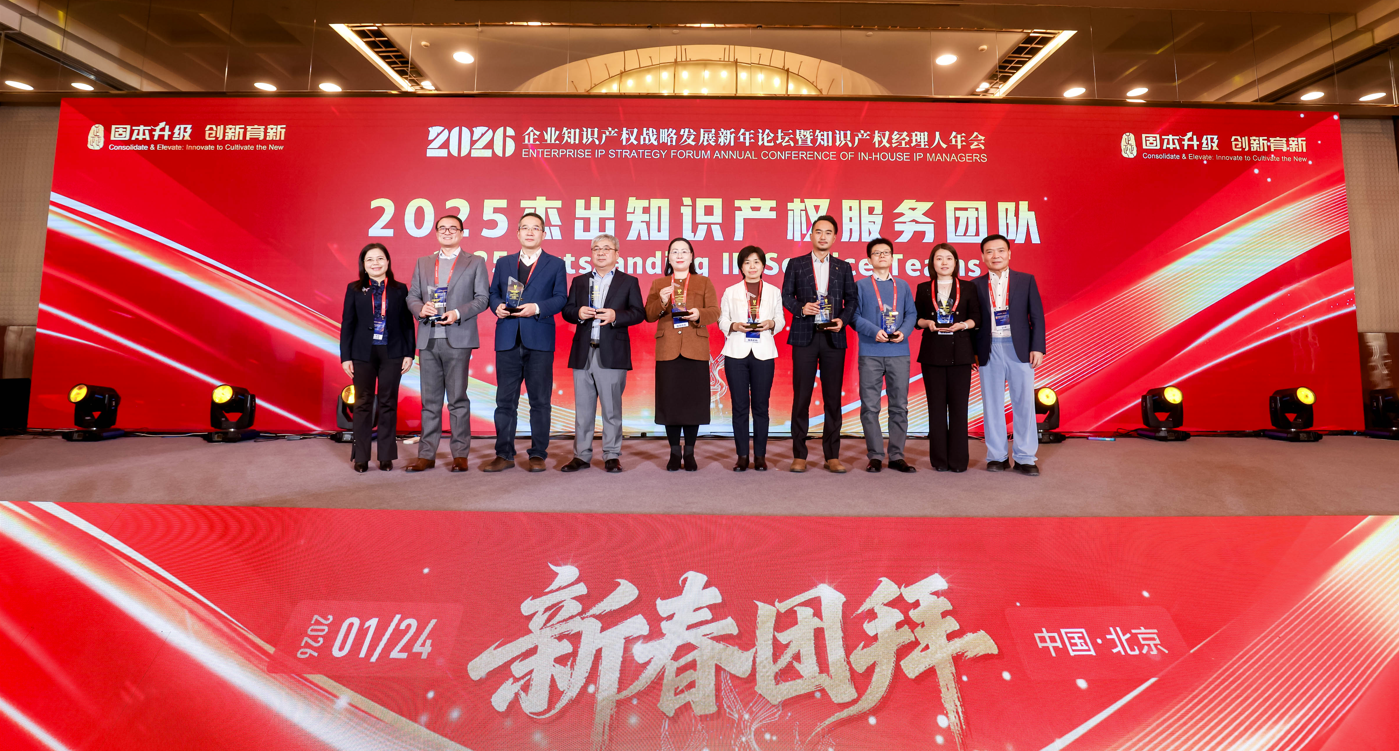
▲ Award Ceremony Moment
The selection process for the “Outstanding Intellectual Property Service Team” evaluates not only the professional expertise, business capabilities, and educational backgrounds of the team’s core leaders and members but also comprehensively assesses criteria such as team stability, representative cases handled, and the significance of major achievements achieved—providing a thorough evaluation of each participating team’s overall strength.
Over the past four decades, Sanyou service team has forged ahead with dedication and resilience. The trust and support of our extensive client base have been instrumental in our growth and progress. We will continue to approach every engagement with a greater sense of responsibility, striving to ensure the successful realization of every innovation achievement.
