






2026/6/24 15:09:32
June
1. Our client awarded full triple punitive damages of RMB 3 million after former agent maliciously infringed and free-riding on foreign brand
Sanyou Client: SCT CHEMICALS FZE
Trial Court: Shanghai Intellectual Property Court
Trial outcome: The appellant's appeal was upheld. Considering the respondent’s degree of subjective fault and the severity of the infringement, the court upheld the appellant’s claim for triple punitive damages and fully awarded the requested compensation of RMB 3 million.
I. Case Background
The appellant, SCT Chemicals FZE (“SCT”), is an internationally renowned supplier of lubricants and engine oils, affiliated with the Germany-based SCT Group. SCT owns the registered trademark “Mannol”. Through years of extensive promotion, the "Mannol" brand and the "SCT" corporate name have attained significant market recognition and goodwill within the industry.
The respondent, a company referred to as “Mai,” was formerly an authorized agent of SCT. Following the termination of the cooperation and authorization agreement, Mai, in pursuit of illicit commercial gains, engaged in a series of malicious infringements and acts of unfair competition, including:
1) Unauthorized use of marks “MANNOL,” “马诺,” and “玛诺” on social media platforms such as TikTok and its official WeChat account to promote its own “MANOIL” engine oil products;
2) Unauthorized printing of SCT’s affiliate name on product packaging, preemptively registering and using the domain name “mannol.com.cn,” misappropriating SCT’s official promotional content, and deliberately creating market confusion;
3) Bulk registration of trademarks highly similar to “Mannol,” and falsely advertising its products as being imported from Germany and representing the “latest upgraded version”;
4) Baselessly disparaging the quality of SCT’s branded products by fabricating false negative claims—such as big noise, excessive fuel consumption, and oil burning—thereby severely damaging the reputation of SCT’s brand.
To protect its legitimate rights and interests, SCT engaged Sanyou legal team to initiate legal proceedings, seeking an order for the respondent to cease infringement, transfer the infringing domain name, publicly eliminate adverse effects, and apply punitive damages. The total claim for economic losses and reasonable expenses amounted to RMB 3 million.
II. Key disputes in the first-instance trial
The court of first instance found that Mai Company had committed trademark infringement, unfair competition in domain name use, false advertising, and commercial disparagement. It ordered the respondent to cease the infringing acts, transfer the domain name, and eliminate the adverse effects through newspaper announcements. However, it only awarded compensation in the amount of RMB 350,000.
In addition, the first-instance court did not recognize a corresponding infringing relationship between the Chinese marks “马诺” and “玛诺” and the English trademark “MANNOL,” nor did it identify “SCT” as a well-known corporate name. The claim for punitive damages was also denied.
In response to the disputed issues and factual discrepancies in the first-instance judgment, the Sanyou legal team conducted a thorough re-examination of the evidentiary record and legal application. Identifying key flaws in the case, the team resolved legal ambiguities and assisted the client in filing an appeal, focusing on four core arguments:
1) The “SCT” corporate name, having been jointly promoted over an extended period, constitutes a well-known corporate name with established influence and should be afforded legal protection;
2) The Chinese marks “马诺” and “玛诺” have established a stable corresponding relationship with the English trademark “MANNOL,” thus constituting similar trademarks. Mai Company’s continued use of these Chinese marks constitutes infringement;
3) Mai Company’s unauthorised use of the “MANNOL” logo to promote its own products plainly constitutes trademark infringement;
4) As a former authorized agent, Mai Company was fully aware of the client’s intellectual property rights. Its infringement was carried out with evident malicious intent, persisted over time, involved multiple forms of conduct on a considerable scale, and resulted in severe adverse consequences. These factors satisfy the statutory conditions for punitive damages. In support of this claim, Sanyou legal team submitted comprehensive and precise calculations of the compensation basis.
III. Second-Instance Judgment
On appeal, the Shanghai Intellectual Property Court fully adopted the arguments advanced by Sanyou’s attorneys, correcting the factual deficiencies of the first-instance ruling and rendering a new determination on both the facts and the applicable law. The appellate court held that the involved Chinese signs had formed a stable correspondence with the English trademark “MANNOL,” and that the client’s “SCT” intellectual property rights were entitled to legal protection. Moreover, the respondent, being a former agent, had acted with clear subjective malice and under aggravating circumstances, thereby meeting the threshold for the application of punitive damages.
In its final decision, the court, taking into account the sales volume of the infringing products, the reasonable profit margins in the industry, and the degree of culpability, applied treble punitive damages in accordance with the law. The court fully sustained our claim for economic losses of RMB 3 million, along with reasonable expenses, thereby delivering a decisive blow to the infringer’s unlawful practice of free-riding on our client’s brand.
IV. Significance of the Case
This case serves as a typical benchmark for the Shanghai Intellectual Property Court to punish malicious infringement by former agents and apply punitive damages. It holds significant reference value for foreign brands regarding intellectual property protection in China.
1) After establishing a stable market correspondence between the English trademarks of overseas brands and their corresponding Chinese logos, they shall be equally protected by law, effectively eliminating the infringement tactics of former agents attempting to attach themselves to the brand through the use of Chinese names.
2) With complete evidence presented, this case successfully applied a treble punitive compensation and obtained full compensation, significantly increasing the cost of malicious infringement and effectively deterring similar IP infringements.
3) It provides replicable experience in safeguarding rights for overseas enterprises against partner breaches and infringements, and maintaining brand reputation, highlighting China's strict and fair business environment for intellectual property protection.
Sanyou Intellectual Property has been deeply involved in trademark, unfair competition, and IP infringement litigation for many years. We excel in handling complex and difficult infringement cases, accurately advocating for punitive damages, and providing comprehensive protection for the brand rights of domestic and international clients.
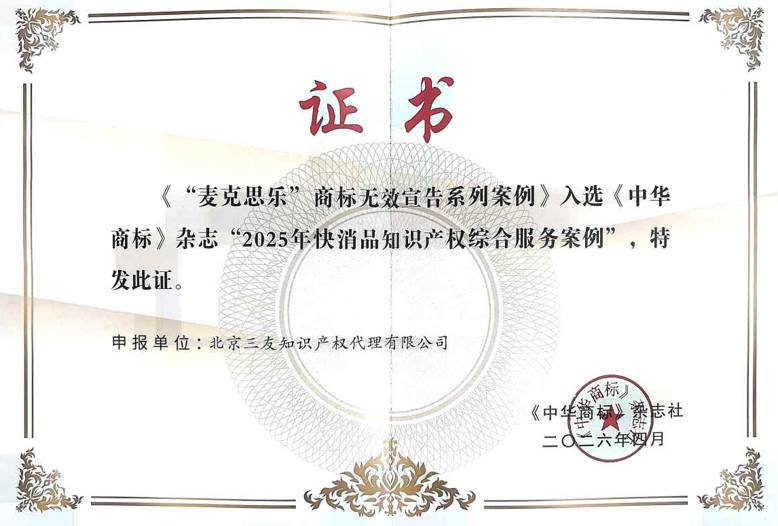
2. Sanyou's "麦克思乐" Trademark Invalidation Series Selected as a Comprehensive IP Service Case for Fast-moving Consumer Goods in 2025
The 4th Fast-Moving Consumer Goods (FMCG) Intellectual Property Service Conference was held in Beijing, where the results of the "2025 FMCG Intellectual Property Comprehensive Service Cases" selection were announced. The "麦克思乐" trademark invalidation series case, represented by Sanyou, was successfully selected for its clear case-handling logic and valuable rights protection outcomes.
The FMCG industry is widely circulated and faces fierce brand competition, making trademarks crucial for enterprise development. This case precisely targets the widespread malicious trademark squatting and brand-riding infringement behaviors, effectively safeguarding brand rights and interests. The case has formed a mature approach to handling cases based on common infringement issues in the industry, providing a reference template for similar disputes.
3. Paper Mail Discontinued for Certain Legal Documents in Madrid 3-year Nonuse Cancellation Proceedings
The Trademark Office of the China National Intellectual Property Administration (CNIPA) has issued a notice announcing adjustments to the delivery method for certain legal documents in Madrid International Trademark 3-year nonuse cancellation proceedings, effective June 5, 2026.
Under the updated framework, the "Notice on Providing Evidence of Use or Justification for Non-Use," as well as the "Revocation Decision" and the "Notice of Case Closure" (the latter two being issued when the registrant fails to respond within the prescribed timeframe), will no longer be dispatched directly to the trademark registrant via paper mail. Instead, these documents will be forwarded electronically to the registrant through the International Bureau of the World Intellectual Property Organization (WIPO).
For Madrid International registrations where the registrant has appointed a local trademark agency to handle the response, the delivery method for the relevant decision documents will remain unchanged and continue to follow the current procedure.
4. China’s Sci-Tech Innovation Advances Toward High-Quality Development: High-Value Patents and Global IP Portfolio Expand
The Institute of Science and Technology Innovation recently released the National Top 100 Science and Technology Innovation Index Report 2026. Based on patent and innovation data from 178 countries and regions worldwide, the report provides a comprehensive assessment of the innovation capabilities of enterprises, universities, and research institutions across three dimensions: innovation capacity, innovation value, and innovation impact.
Among the top 500 enterprises, 258 are state-owned or state-controlled (51.6), while 242 are privately owned (48.4). The industrial composition is dominated by computer communications and electrical machinery manufacturing, which together account for over 23 of the total. Within the private enterprise segment, 131 are recognized as manufacturing national champions. Innovation resources continue to concentrate in strategic emerging sectors, including integrated circuits, artificial intelligence, new energy, advanced materials, and quantum technology.
In terms of intellectual property, the cultivation of high-value patents and the expansion of international patent portfolios stand out as notable trends. Over the past three years, the top 500 enterprises have filed more than 340,000 invention patents annually, with an authorization rate approaching 60. Their cumulative PCT international patent applications have surpassed 78,000, representing 52.1 of all PCT applications filed by enterprises nationwide. Leading innovators such as Huawei, CATL, TikTok, and BOE have each filed over 3,000 patents, and their sustained efforts in overseas patent deployment have steadily strengthened their international competitiveness.
The top 100 universities filed and were granted nearly 1 million patents over the past three years, accounting for 57.3 of the national total for higher education institutions. Similarly, the top 100 research institutions hold 47.0 of all patents filed and granted by research organizations nationwide. Their PCT applications make up 65.6 and 80.2 of the respective totals for universities and research institutions, positioning them as key pillars supporting the internationalization of China’s scientific and technological achievements.
Among the top 100 innovative universities, Zhejiang University, Tsinghua University, and Harbin Institute of Technology secured the top three spots. In the Top 100 research institution ranking, the top three are China Electric Power Research Institute, Xi’an Thermal Power Research Institute, and Shenzhen Institute of Advanced Technology (Chinese Academy of Sciences).
